
A Heavenly banquet at a folding table
A Thanksgiving reflection on broken relationships, God’s reconciliation, and serving a feast on a folding table.
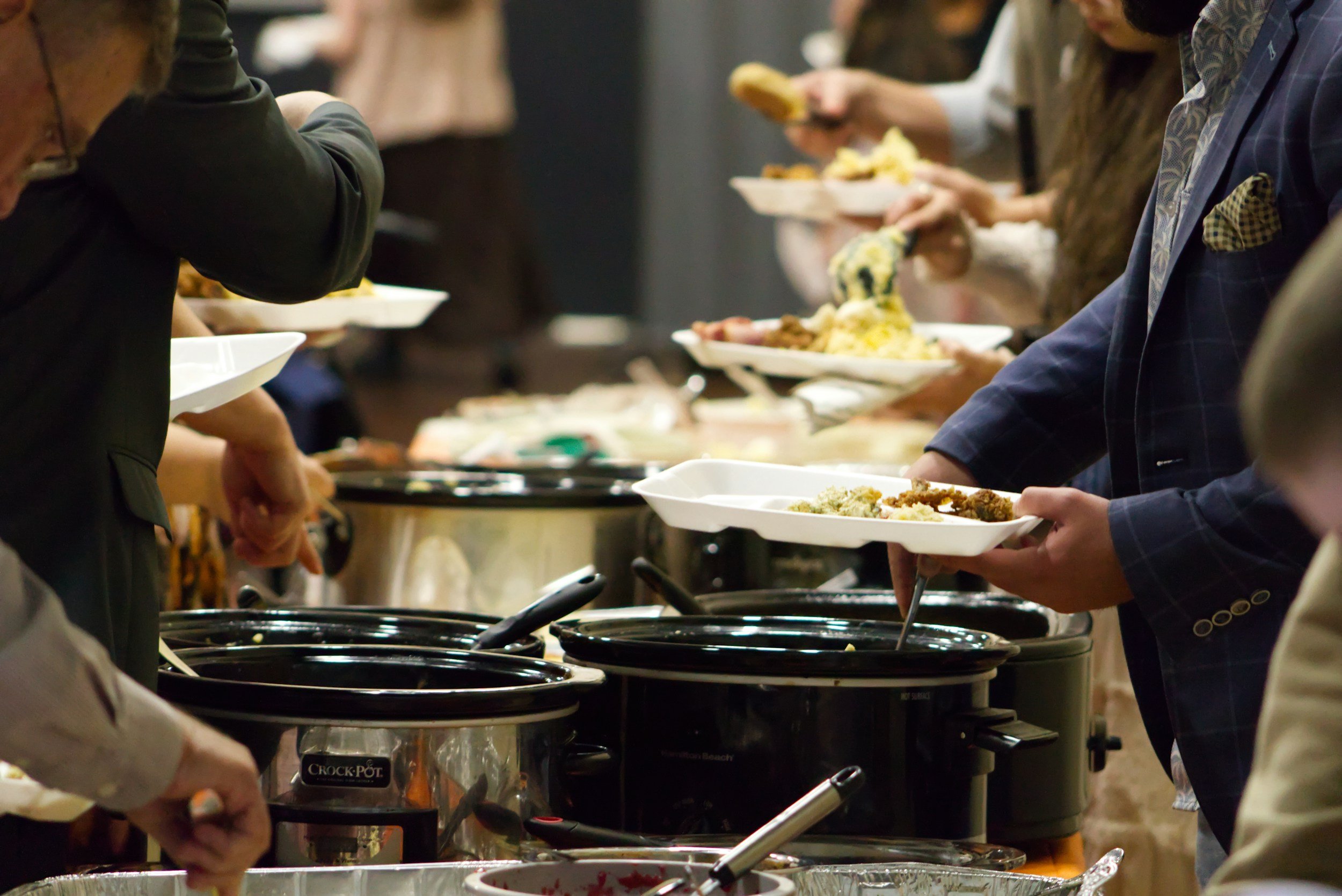
Does the Heavenly Banquet from Isaiah 25 include Crock Pots? Scholarly opinion is divided.
This essay is adapted from a sermon I preached on November 25th, 2025 at North Congregational Church in Woodbury, CT as part of the Woodbury-Southbury Interfaith Thanksgiving Service.
Isaiah 25:6-10a CEB
On this mountain,
the Lord of heavenly forces will prepare for all peoples
a rich feast, a feast of choice wines,
of select foods rich in flavor,
of choice wines well refined.
He will swallow up on this mountain the veil that is veiling all peoples,
the shroud enshrouding all nations.
He will swallow up death[a] forever.
The Lord God will wipe tears from every face;
he will remove his people’s disgrace from off the whole earth,
for the Lord has spoken.
They will say on that day,
“Look! This is our God,
for whom we have waited—
and he has saved us!
This is the Lord, for whom we have waited;
let’s be glad and rejoice in his salvation!”
The Lord’s hand will indeed rest on this mountain.
If we were to take a poll, I bet it would show that Thanksgiving is everyone’s favorite holiday. There’s no gift-giving obligations, minimum church attendance expectations, and, in my humble opinion, features the best food of the year. It is a judgement-free pass on all-you-can eat pie, including a pie-for-breakfast option. The world outside seems to slow down for a day or two, and post-dinner napping is encouraged.
As a young adult far away from home Thanksgiving became a holiday I spent with friends rather than family. My college friends and I would prepare meals with the finest thrift-store-quality cookware in our college apartment kitchens. We were young adults experimenting with preparing turkeys in questionable ovens, frantically leafing through cookbooks to find out what to do if your bird is still frozen on Thanksgiving morning. One memorable year I learned the hard way that if the Korean mini-mart down the street is out of buttermilk, melting butter into whole milk is NOT an advisable substitute.
Spending Thanksgiving with my friends while I was in my 20’s was something that I chose in part because of necessity: I was going to school in Boston and my family lives in Oregon. Flying home was expensive and grueling. But that wasn’t the only reason. For years, the big sit-down family meals would generate in me more anxiety than anticipation. I know I’m not the only one who has experienced this.
There can be as many reasons for holiday-based anxiety as there are families. For me and my sister, the anxiety had to do with a family divided by divorce. My parents divorced when we were really young, four and two. The split was acrimonious. For years, navigating the custody agreements and calendar could make negotiating a complex multi-national cease-fire agreement feel like child’s play. Wherever we were, with my mom’s family or dad’s, there was always the sense of guilt that we were in the wrong place doing the wrong thing. Where we were going to be (and not be) for every family holiday meant that everyone felt a range of bad, from a little to a lot. This was no way to celebrate a holiday. As a young adult it was a relief to be able to opt out.
Until the year everything changed.
After I had moved back to Oregon, my mom had started hosting a giant “y’all come” Thanksgiving dinner in her small ranch-style house. We did our best to defy the laws of physics to fit as many people as possible into the living-room-turned-dining room, with folding tables and chairs borrowed from her church. Couches were hauled into the garage. Family Bibles and Webster’s Dictionaries became booster seats for the very small. Aunts and uncles and cousins and friends arrived bringing snacks and sides and beverages to share. Mom’s Thanksgiving dinners were always big and loud and messy and delicious.
Meanwhile, my dad and stepmom and grandparents and aunt and uncle would gather around a smaller, much quieter table.
One year, my sister decided that enough was enough. My sister is very strong-willed, and when she makes a decision, that’s it. She was the kind of kid who would agree to whatever it was you were saying and then proceed to do things the way she wanted to do them. As an adult she shed the need to pretend that she was going to just go along with other people’s plans. It is one of the things I admire most about her.
That year, my sister decided that she was done with having two family meals, so she informed our mom that she had invited dad’s side of the family to Thanksgiving and that they had said yes.
Suddenly I had a whole new thing to be anxious about. How was this going to work? Would this be the culmination of all of my childhood anxieties played out in real time? What would it look like to make a place for my dad’s family at my mom’s (folding) table? As the days leading up to Thanksgiving got closer, I imagined many possible scenarios for how this would play out, all of them bad.
I assure you that none of them even came close to the vision of the heavenly banquet that we read about in Isaiah 25.
After having an astounding, ecstatic vision of God, the 8th century prophet Isaiah was commissioned to speak powerful words on God’s behalf to the people of Jerusalem. God was not happy with the corruption, idolatry, and oppression of the poor that he saw in Jerusalem, the spiritual home of his very own people. The people of Israel were in a covenant agreement with God, a partnership, a marriage. Through his prophet Isaiah, God needed his beloved people to know that, when they privileged the wealthy over the poor, when they chased after idols - either literal, like Ba’al, or figurative, like power - their covenant had been broken.
The prophetic words of Isaiah describe what would happen as a result of this broken relationship. There are images of God’s judgment woven throughout the first 39 chapters of the book, predictions of the destruction of the “Old Jerusalem.” Bigger, meaner nations like Assyria and Babylon would come like a “refiner’s fire” (the very same one from Handel’s Messiah), razing the Lofty City. These are terrible visions meant to strike fear in the hearts of the hearers, should they have the ears to hear.
But the thing about Isaiah’s God is that Judgement is never the final word. Here, in chapter 25 we hear that even a nation that has slid into corruption, oppression, and greed can be redeemed. Even a people willing to worship things that don’t give life and life in abundance will not be obliterated. The framework of their lives would certainly be torn down, but the people would be saved. Isaiah says that God is tearing down in order to build something new.
And what does that new thing look like?
A feast. A banquet. A huge table filled with rich foods and wines that have been aging since the time of creation. God - the general God, the warrior God - will put down his sword and picks up a chef’s knife to prepare this amazing meal, but with a twist: this table has been prepared, not just for some people, not just for members of the New Jerusalem, but for ALL people.
The end of death, the end of suffering, is portrayed as a feast where everyone has a seat at the table. The end of sorrow feels like the author of creation tenderly wiping away the tears from every eye.
Isaiah is not making a rational argument for the goodness of God, nor a carefully crafted intellectual appeal for Why We Should Not Oppress Our Neighbors or Why We Should Not Worship False Idols. This is a physical, sensual, visceral description of
what the true reign of God will be like. Isaiah grants us insight into the architecture of creation. The image of the heavenly banquet is a glimpse of what the Holy of Holies intended for us all along. God has set the table for us, laden with every good thing, not just for survival, but for pleasure and for joy. And not just for some, but for all.
Isaiah’s God wants us to see the reward that’s worth the pain of change, of letting go of our comfortable, broken models of being and relating, of giving up our little idolatries and oppressions. The words of the prophet make it plain that we can either put an end to our corporate selfishness or God will do it for us - one way or another it will happen.
The prophet also makes it plain that when our selfishness and cruelty have been burned to the ground, there will be a banquet with an infinite number of chairs, with plenty of good food for everyone, and fruit of the vine to bring pleasure and joy for all.
The Hebrew Bible is an ancient sacred text is filled with a thousand collected years of attempting to describe, understand, and relate to the Holy. There are certainly other books, other traditions, some that build on this story of God in the world - the books of the New Testament documenting the saving work of Jesus and his followers - and others that amplify the Abrahamic faith and tradition - as does the Prophet Mohammed in the Quran. There are still other sacred stories from other parts of the world where other people have also sought to describe, understand and relate to the Holy, some with ancient written texts and others with different means of passing along wisdom and experience. At their heart, they all say the same thing (and I’m paraphrasing here): Love your neighbor as yourself. Build a bigger table. Add more chairs as needed.
Faithful people in all places and all times have discovered and rediscovered that our survival depends on mutuality and care for one another. Centuries upon centuries of prayer and worship, teaching and learning, can be distilled into this essential truth: the only way we are going to get through this life is to make space for one another in community.
God knows, this kind of change doesn’t come easily. There is discomfort in cultivating humility, of turning our tribalism into generosity. We may have to do the action of hospitality with awkwardness for a while. We may need to “fake it ’til we make it” when letting go of those things that keep us comfortably siloed. But God never promised that a faithful life would be a comfortable life: instead God promised that it would be good.
Which brings me back to Thanksgiving.
After weeks of my own anxiety about what would happen, Thanksgiving day came. I was already at my mother’s house, part of the frenzy of preparation, when the knock came at the door. After a freighted moment, my mom wiped her hands on her apron, went to the door and opened it.
I watched as she welcomed my grandparents, my stepmother, and even my dad with a hug. We all smiled nervously at each other as coats were hung up and beverages were poured and seats were found. It was definitely awkward -really awkward, in fact - until it wasn’t. The dinner was served and it went along fine, conversation continuing remarkably easily all the way through pie and coffee. Before we knew it, coats were slipped on and “goodbyes” and “thank you’s” were shared with more hugs, and then it was over. And then next year they came again, and we did it all over again, and it was easier and better.
I wouldn’t advise this situation for all families and relationships. My parents’ time of active anger and hurting each other had cooled off years ago. No one’s humanity was in question, no one was in danger or trauma. Reconciliation is not possible when safety of heart, mind, or body is not guaranteed. Even so, after years of division and resentment everyone had to fake it a bit to get along that year, and even the year after that and maybe even the year after that until a new way of being and relating had truly been established.
My parents would never be best friends even after all that, which is more than okay. Reconciliation means creating a new way of being, not re-creating some old way. That they could be in relationship at all while living into new (and better) lives was the evidence of God’s abundant grace, what Isaiah would describe as “the New Jerusalem.” For my family, once the idols of comfort and resentment and bitterness had been cast aside, new and abundant life became possible. Grace and Reconciliation looked like a crowded living room where everyone found a place for themselves at the table.